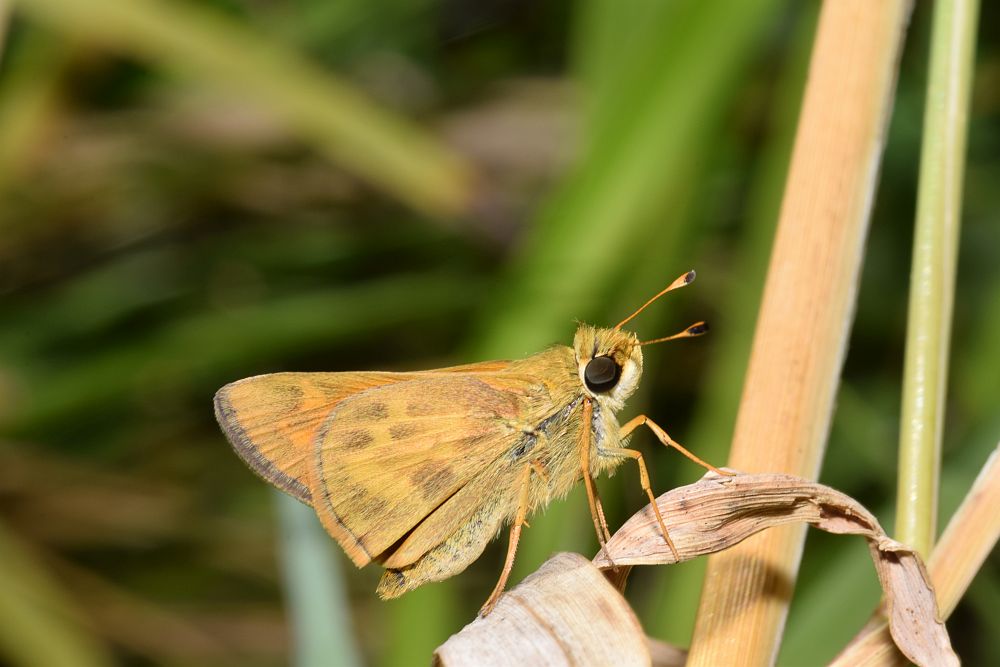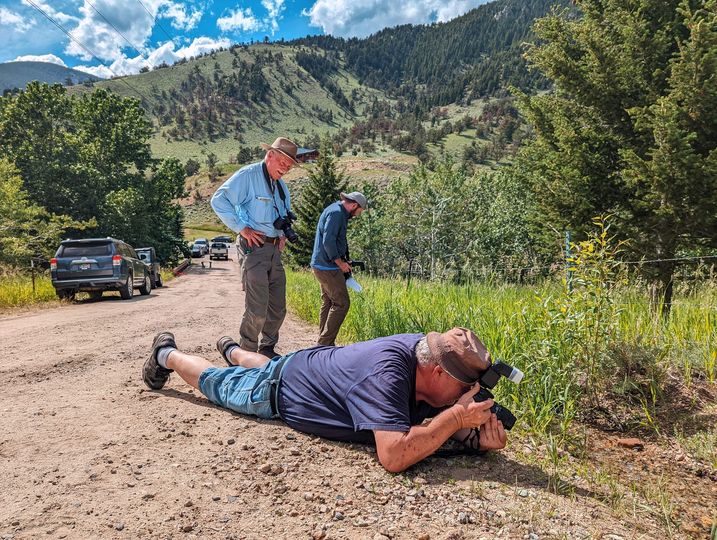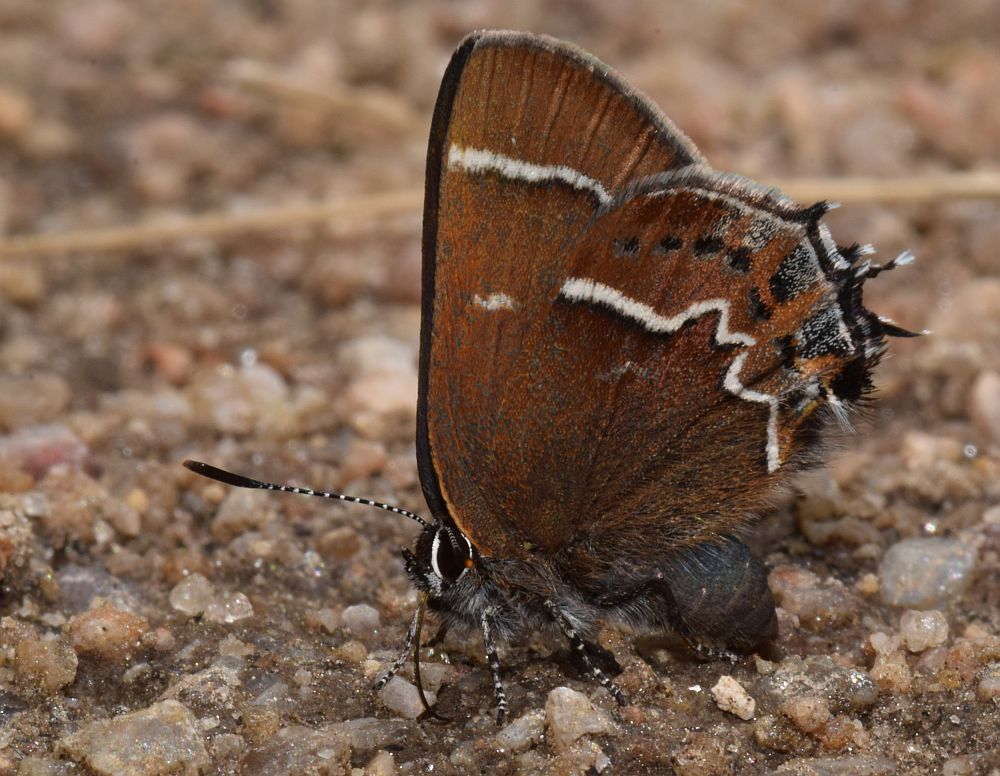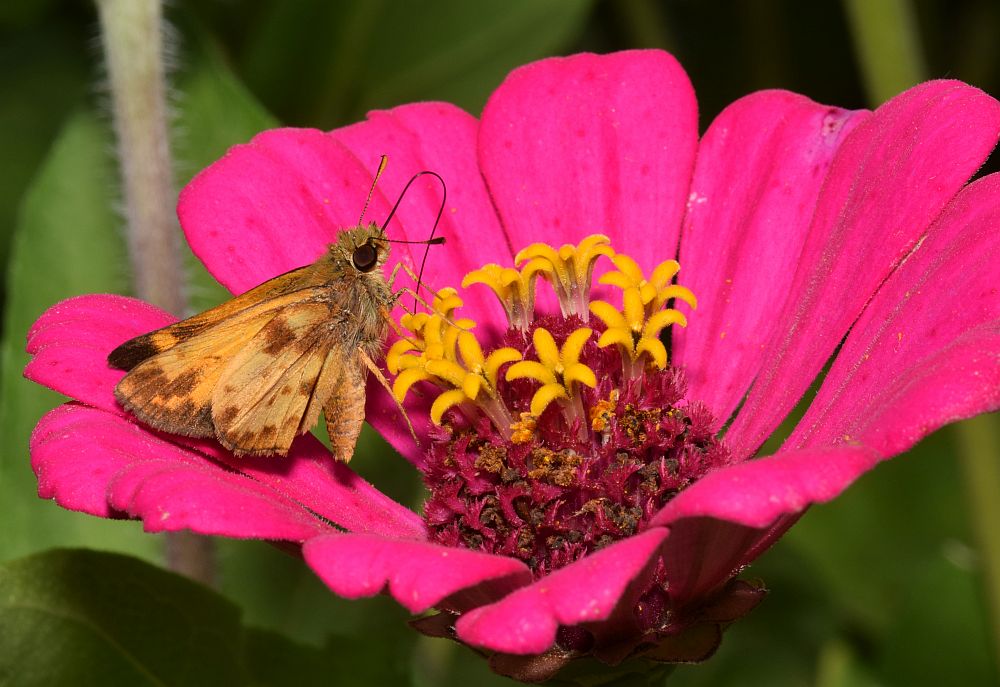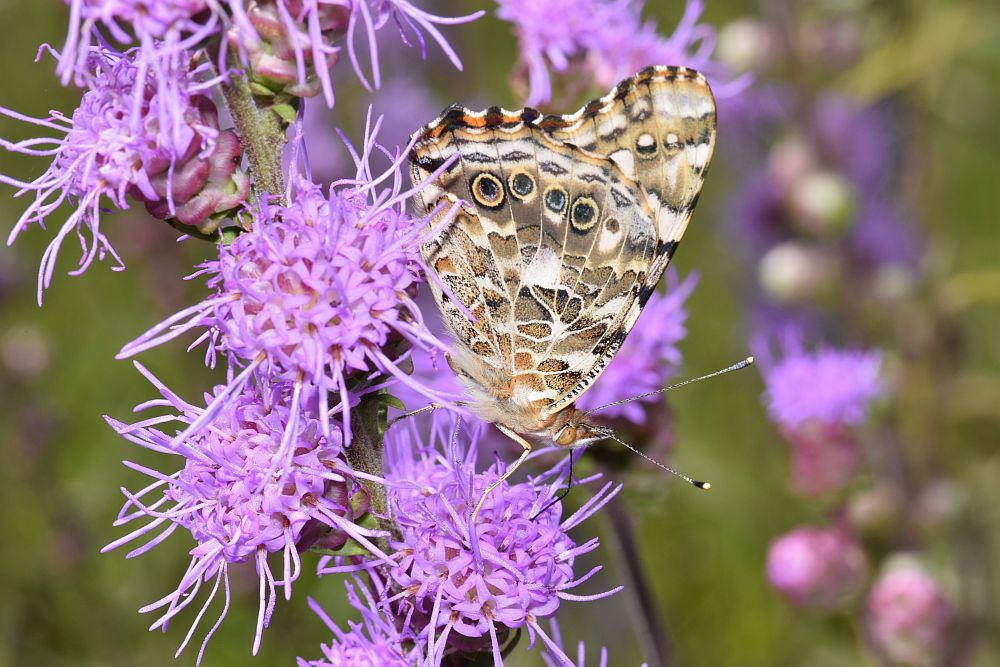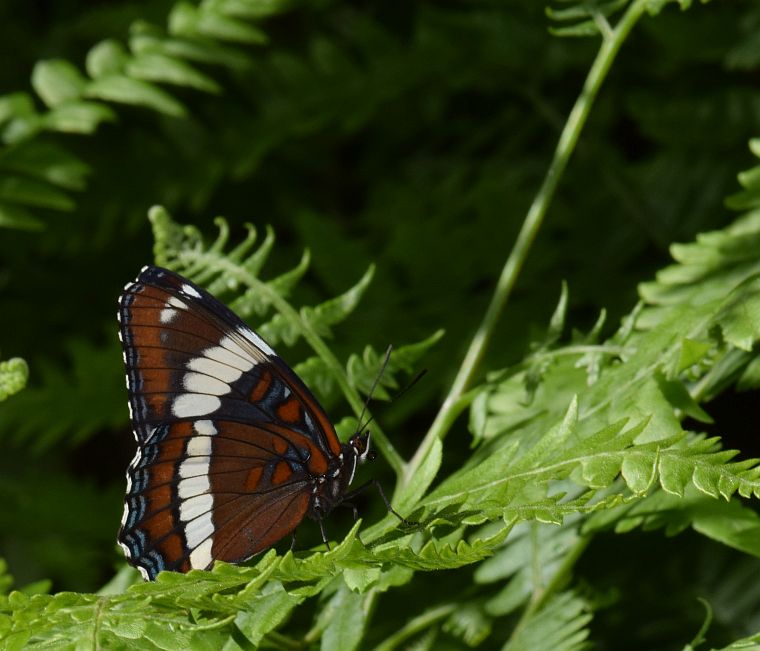
Mourning Cloak Butterfly

I saw this butterfly a number of times before I was able to photograph it.  In fact, while I was chasing it, it landed on me several times.  I did not get a picture, but it flew close enough that I heard its wings flapping.

A day or two later I saw it again.  I can’t be sure, but I think it was the same one.  I watched it fly up and land again.  On this bright, sunny day the butterfly always seemed to land in the deep shade, only inches from the sunlight.

I chased it and got a photo–I had to use flash because of the light.

6-17-130005

Then there were two.  They circled around each other against the blue sky with lovely white clouds.  It would have made a great photograph if I had been fast enough.

But I wasn’t.  Maybe next time (if there is a next time).

Posted in butterflies | Tagged , , , , | Leave a comment

Notes on the Discovery of the Poweshiek Skipper

June 21, 1870
henrywparkerThe Poet felt strangely nervous as he packed the nets and the jars in the back of the buggy. It should have been a pleasant task. After all, the poet loved the sunshine and warmth of the June morning that would remove the dew from the grasses and expose the colorful flowers. The air would smell so fresh and clean. Helen would be at her best—almost back to the picture of loveliness that he had married some 18 years earlier. Her sorrow would melt away as they chased butterflies on the prairie slope, and she would be happy for a time. Her focus would be on the mission at hand.
This was to be the third trip in as many weeks to find Helen’s butterfly. Helen suggested to the Poet that this butterfly did not live long as an adult, so to find it you had to be out in the prairie when it emerged. And then there was the move coming up—if they didn’t find it this year there would not be a second chance. They needed fresh specimens. The individuals Helen had collected were battered and damaged from their short lives and from the constant handling and observation of the specimens. One could describe the species from these, but there really needed to be more.
So instead of a relaxing morning out of doors collecting a few butterflies, followed by a picnic, it would become a frantic search for a small and somewhat inconspicuous butterfly. Failure to find it would result in deep disappointment.
They followed the road a few miles north of town. They came to a wooden gate which the Poet opened. Entering the enclosure, they closed the gate and unhitched the horse. They left their lunch in the buggy, and rode bareback, the Poet in back and Helen in front, holding the nets and jars, for about a quarter of a mile to the steep slope with the prairie pasture.
There was a deep cut through this pasture, at the bottom of which a brook spread itself broadly over the pebbles, and was then gathered into a narrow way between grassy banks, and glided into a pond in a field beyond, where the frogs sunned themselves all day, and croaked all night.
Helen inspected the vegetation and slowly weaved the net back and forth across the short grasses before the Poet was off his horse and had tended to it. The Poet looked around, and immediately spotted a stunning Argynnis idalia, dark brown with brilliant silver glistening in the sun. It was working its way around Echinacea pallida, stepping over the spikes of the coneflower as it gathered nectar from the gaps between the spikes.

huntera

huntera

A few Pyrameis huntera caught the Poet’s eye. Then a trio of Scudder’s dione. Scudder’s list of Iowa’s butterflies had been a wake-up call for Helen and the Poet. No one had collected more Iowa butterflies than they had, yet they had been slow to publish, and Scudder had beaten them to it.

Scudder's dione

Scudder’s dione

Chrysophanus dione was a new species, but they already had many in their collection. Scudder listed four species as new, out of forty six. They weren’t sure about the other three, but they had one that Scudder did not mention—a lovely Hesperian, dark brown with pale yellow hind wings with conspicuous white veins. They would name it Powesheik, after the county and the Indian chief they had both seen as children.
Helen let out a yell. She had one. The Poet rushed to her side, ready to assist, but she already had it in the killing jar. The butterfly trembled in the jar—it would continue to tremble until its life force was gone and it would remain soft and pliable so it could be easily pinned.

tharos

tharos

Then the search went on in earnest. More of the small butterflies were captured, along with Lycaena comyntus and Melitiva tharos, which were released. The Poet was starting to think the trip was a resounding success. He lost track of the numbers, but thought they had to be in the high twenties. When the last of the killing jars was readied, a sweep of the net came up with four individuals of the new species. He put them in the jar and watched them tremble. Then he felt a strange weakness, and looking up saw, near the brook, a figure of a man on a horse. Powesheik? But he felt the jar slip from his hands, and he had to look down to catch the jar. When he looked up again, he did not see the Indian, nor any sign that he had been there.
Helen was happy, and satisfied that they had accomplished their task. She was nearly her old self as they carefully packed up the nets and the specimens and road back to the buggy. The Poet felt something strangely different. He felt a weariness mixed with panic and maybe a sense of impending doom. Was it the vision of Powesheik that so drastically changed his mood, or was it something else?
It was a nice day for a picnic, and Helen chatted happily as she laid out the blankets and prepared the meal—fresh bread, ham, and a handful of wild strawberries that Helen had picked after they left the prairie. The Poet’s mood had quieted—he was nearly calm, with just a hint of wariness. They packed up their things and left the enclosure.
When they arrived back in Grinnell, Helen went right to work pinning the butterflies. They had already written the description, and with a few modifications had it submitted for publication. Over the next few days they finished packing for the move back east.

Posted in Uncategorized | 1 Comment

An Eastern Tailed-Blue

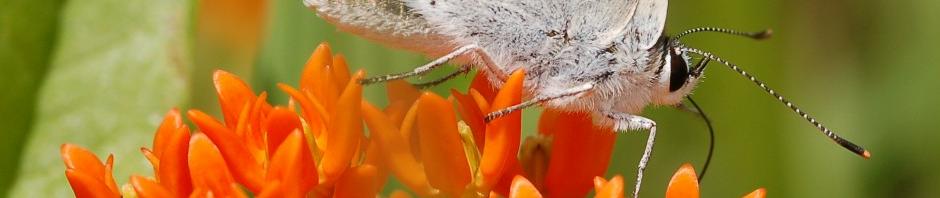
This year has been slow for the butterfly watchers.  I have seen only a few butterflies per day recently, and had a streak of about a week where I did not see any.

Yesterday was hot and rainy, with dark clouds all day.  Not good butterfly weather.  But I did manage to see four species–maybe eight or nine individuals.  One of them was this male eastern tailed-blue.

6-15-130043

The eastern tailed-blue is Everes comyntas.

Posted in butterflies, eastern tailed-blue | Tagged , , | 1 Comment

Front Porch Thoughts

When life gets me down, I like to go to my front porch and renew my soul.

Some days stuff just gets you down.  I have a terrible summer cold–my sinuses are dripping and my throat is sore.   I feel like crap.  The weather has been pretty gloomy–dark and rainy, or hot and very humid.  I have been dealing with a host of small problems that don’t seem to go away.

But if I sit on my favorite chair on the porch maybe I will feel better.

Not so much today though.  A cat has crapped on my favorite chair.  There is a tomcat that usually sits there, and I have been moving him when I need the chair.  I wonder if he did it, and if so, did he do it on purpose?  I’m kinda starting to think so.

But I washed off the chair, and turned it upside down so the cat can’t get to it.  I sat and listened to the birds for a while.  Then I started noticing the flowers.

6-15-130022

This spiderwort is at the end of the porch steps.

I am starting to feel better already.

Now I just need to get even with that cat…

Posted in photography, Uncategorized | Tagged , , , , | 1 Comment

cum omnibus deficiat ludere mortuis

That’s Latin for “when all else fails, play dead.”

At least that’s what Google says.  The Red Green show uses a different phrase, but it may not be in a real language.

6-11-130028

This weevil is Lixus, possibly L. convacus, the rhubarb weevil.  I did collect it from a rhubarb leaf.

6-11-130033

Here it is a moment later.  No longer mortuis.

Posted in insects | Tagged , , , , , | 1 Comment

Really Red

The other day I photographed an insect that had the brightest red color I think I have ever seen.

6-10-130026

Turns out it is a sawfly–a type of wasp.     Its caterpillar-like larvae eats poison ivy.

6-10-130034

Its name is Arge humeralis.

Posted in insects | Tagged , , , , | 2 Comments

An Abundant Fly

A very small, dark fly has suddenly become the most abundant creature in the yard.  The bushes are full of flowers, and each flower has two or three of these flies.

6-10-130004


Posted in Uncategorized | Leave a comment

More Flowers in the Ditch

Another flower we have in our ditches is Canada anemone, Anemone canadensis.   This one also grows in wet spots in our fields, and probably was not planted in the ditch by humans.

6-9-130001

I should have used a tripod and gotten a lower angle for this photograph, but the ground was wet and muddy.  That does not always stop me, but it did today.

Posted in plants | Tagged , , | Leave a comment

Blue Flowers in the Ditches

We have a long history of habitat modification due to intensive farming here in Iowa.  One consequence of that is the lack of much of our native plants.  The roadside ditches essentially  became monocultures of grass that requires frequent mowing.

A few years ago some people at one of our Universities decided to change the approach to the management of the right-of-ways alongside public highways.  They introduced a concept called “Integrated Roadside Management”, which re-introduced plants from the prairies back into roadside ditches.   They created a political structure to get the project started, and the County that I live in has used the concept on our roadways.

As a result, we have some of this lovely blue flower in our ditch.

6-8-130003The flower is the large-flowered beardtongue, Penstemon grandiflorus.  It is native to Iowa, although it is a little more common about 50 miles to the west of here.  I am sure it is in the ditch because of the integrated roadside management program, and not part of a prairie remnant.

6-8-130007

Still, I am glad it is here.  It is a very nice flower.


Posted in plants, rural scenics | Tagged , , , | 1 Comment

One Reason the List Was Published

In 1850, Helen Fitch (later Helen Fitch Parker) tried to publish a description of a new species of snail by having her future Brother-in-Law present it as a paper before the American Association for the Advancement of Science.  Louis Agassiz may or may not have figured it out, but he did publicly criticize Samuel Parker for not comparing the new species against all known species.

Academy of Science

So how would you avoid the same criticism in the description of a new species of butterfly?  Would you say: “I compared this butterfly against all the other butterflies I could identify?”  Or would you be a little more subtle when you described your next new species 20 years later?

So they published the list in April, then they referred to the list in the description.

description1

The complete description can be found here.

Posted in Helen Fitch Parker, Henry W. Parker, oarisma poweshiek | Tagged , , | Leave a comment